
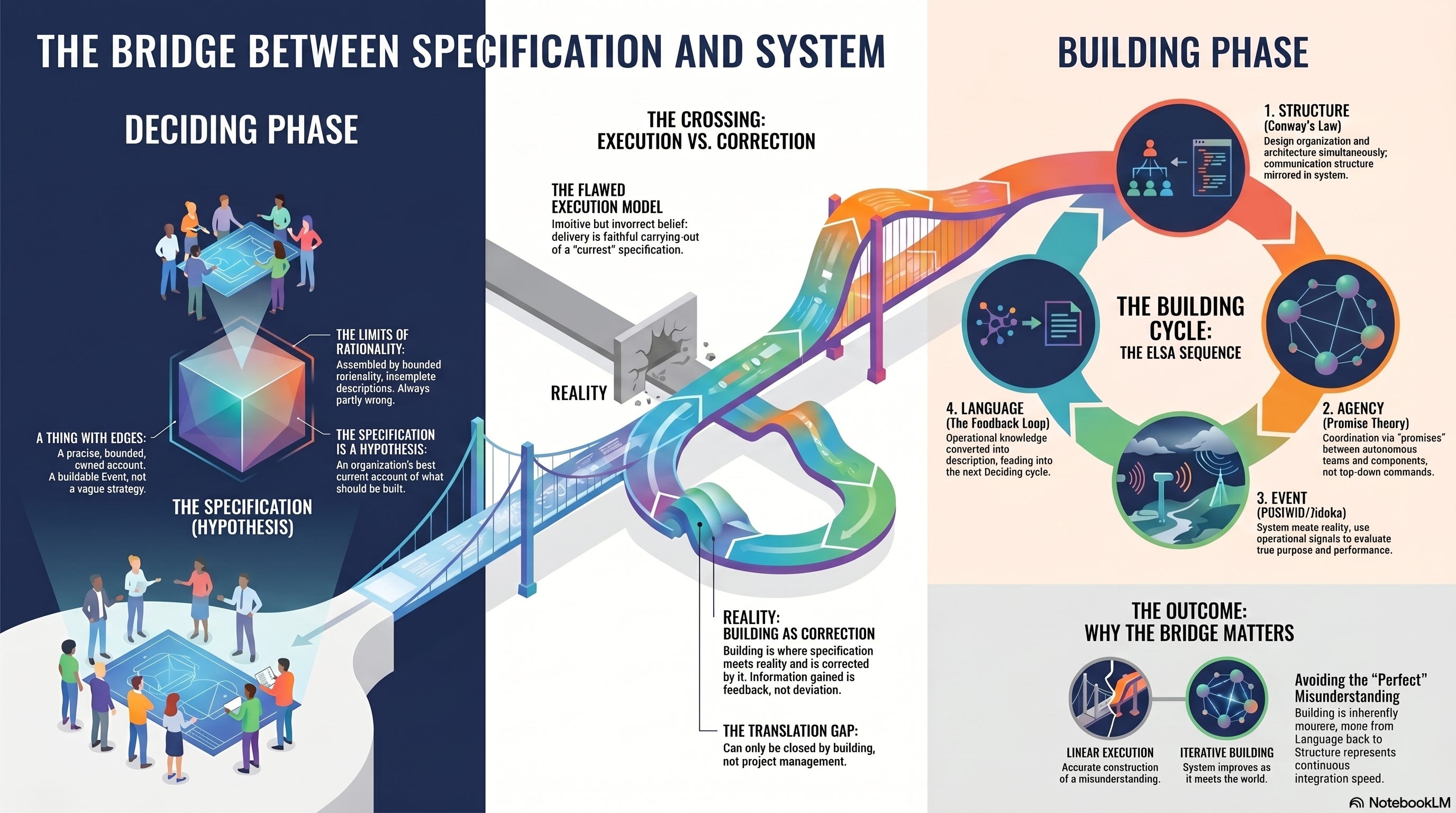
A specification is not a system. It is a precise account of a system that does not yet exist, and the distance between the two is the distance this article is about. Deciding ended with an organisation that had, at last, converted its situation into something buildable: a bounded, described, owned account of what it had decided to make true. That account is real work, hard-won. It is also, on its own, inert. Nobody has built anything.
Every phase of this series ends by producing something the next phase cannot directly use. The gap is the point. Learning ended with a capacity, and a capacity is not a description, so Deciding had to begin by applying it to produce one. Deciding now ends with a specification, and a specification is not a system, so Building has to begin by constructing it into one. The transition is never a clean pass. It is a translation, and the thing being translated changes its kind in the crossing. This article is that translation: what deciding actually produced, why it cannot be handed straight to delivery, and where building has to start instead.
1. What Deciding Produced
Deciding ran a particular path. It began with Language; the discipline of describing the domain precisely enough to decide within it at all, Ohno’s work and Evans’s. It moved to Structure; understanding how the parts of the organisation relate when a decision is made, Beer’s work and Conway’s and Ackoff’s. It moved to Agency; the capacity of the people deciding to commit, to exclude, to choose rather than default, Simon’s work and Boyd’s and Kegan’s. And it ended at an Event: not a disruption arriving from outside, but a specific, bounded, buildable thing produced from the inside. The decision, properly made, is the Event. It is the trigger.
This matters because of what kind of object the Event is. It is not a strategy, which is a direction. It is not an intention, which is a wish. It is a specification: precise enough that someone other than its author could build from it, bounded enough that its edges are known, owned by someone who will answer for it. Deciding, at its honest end, does not produce a better opinion about what to do. It produces a thing with edges. And a thing with edges can be handed to someone else, which is exactly what makes the next phase possible and exactly what makes it dangerous.
2. Why the Specification Cannot Simply Be Executed
The intuitive model of what happens next is execution: the specification is correct, delivery is the faithful carrying-out of it, and the work is to manage that carrying-out efficiently. This model is wrong, and the whole of the argument so far has been quietly arguing against it.
A specification is a hypothesis. It is the organisation’s best current account of what should be built, and like every account it was assembled by people of bounded rationality, working from descriptions that were necessarily incomplete, inside a structure that shaped what they could consider. It will be partly wrong. This is not a failure of the deciding; it is the permanent condition of deciding, and the phase named it repeatedly. Schön called the alternative the swampy lowland, where real problems live and textbook procedures do not reach. Building is not the execution of a correct specification. It is the activity in which the specification meets reality and is corrected by it.
Which means the relationship between Deciding and Building is not sequential in the way a plan is sequential. The specification is the input to Building, and the operational knowledge Building generates is feedback that re-enters Deciding for the next pass. The transition is a translation precisely because a specification and a system are different kinds of thing, and the difference cannot be closed by careful project management. It can only be closed by building, and by treating what the building reveals as information rather than as deviation.
3. Why Building Starts at Structure
Each phase of the series enters its cycle at a different point, and the entry point is forced by what the previous group left behind. Building begins at Structure, and the reason is exact: a specification has to be constructed before it can do anything else, and construction is, first, a structural act.
Structure here has the literal Conway meaning. The teams that will build the thing, and the components the thing is made of, are the same shape; the communication structure of the organisation is reproduced in the architecture of what it builds, and this is not a tendency to be managed but a law to be designed with. Building starts by deciding the structure twice over: how the work is divided into teams, and how the system is divided into components, knowing that those two divisions will mirror each other whether or not anyone intends it. Deciding made structure visible as the thing that shapes decisions. Building makes structure the first thing constructed, because everything built afterwards inherits its shape.
This is the cleanest reason the bridge cannot be skipped. An organisation that takes a specification and moves straight to delivery, without first treating structure as the opening design decision, will get the architecture its existing org chart dictates, and discover the mismatch only when the system is built and rigid. Building starts at Structure so that the shape is chosen rather than inherited.
4. What Building Will Argue
Building runs its own path; Structure, then Agency, then Event, then Language; and although its full architecture belongs to the articles ahead, the shape of its argument can be set out here, because it is what this bridge points toward.
After Structure comes Agency, and Agency in Building has a dual meaning that becomes the central move. There is the autonomy of teams: whether the team that owns a component can make decisions about it without hierarchical mediation. And there is the agency of components themselves: in a system of services and software agents, each part makes promises about what it will do and what it will not do, and the coordination between autonomous parts is the promise, not the command. Building takes Promise Theory as its anchor for exactly this reason; it is the account of how autonomous agents, human or software, coordinate without a controller. Then comes Event; what happens when the built thing meets reality, the continuous signal from a system in operation, where Beer’s POSIWID and Ohno’s jidoka return as the disciplines of evaluation. And then Language; what the organisation learns from what it built, operational knowledge becoming the description that feeds the next cycle.
Building is inherently iterative in a way the earlier phases are not. Its final position, Language, feeds straight back to its first, Structure, for the next pass. Continuous integration, continuous delivery, continuous feedback: these are not modern delivery fashions but the Building cycle running fast. There is also a warning this bridge should name now. A system of autonomous parts coordinating through promises still depends on something the structural account cannot supply: the energy that keeps autonomous teams moving rather than draining. The cadence of a building organisation; its standups, its demos, its retrospectives; is not administrative overhead. It is where that energy is generated or lost, and the articles on building treat it as seriously as they treat architecture.
5. The Handover
So the bridge can be stated plainly. Deciding produced a specification: a bounded, described, owned account of what to build, which is a hypothesis and not a certainty. Building takes that specification and begins, at Structure, to construct it into a system; divides the work and the components together; gives the parts genuine autonomy and binds them by promises rather than commands; lets the built thing meet reality and treats what reality says as information; and turns that information into the language that starts the next cycle.
The gap between the two phases is real and it is not a defect. A specification handed straight to execution, treated as correct and carried out faithfully, produces a system that is an accurate construction of a misunderstanding. A specification carried into Building, treated as a hypothesis to be constructed and corrected, produces a system that gets better as it meets the world. The difference between those two outcomes is the entire reason this bridge exists, and the entire reason Building is a phase in its own right rather than a delivery function bolted to the end of Deciding.
Deciding asked how an organisation gets clear on what to do. The Building articles ask the harder and more exposed question: how an organisation builds an effective response, and stays honest with itself while reality tells it what it got wrong. That is where the series goes next.
One orientation before the change of question. The series runs four phases; Learning, Deciding, Building and Transforming. Each enters the same four moves one position later than the last, so the four phases together complete a single turn: Learning at Event, Deciding at Language, Building at Structure, Transforming at Agency. From Learning to Clarity was the previous bridge, and The Build Is the Test opens the stretch this one leads to.
I write about the industry and its approach in general. None of the opinions or examples in my articles necessarily relate to present or past employers. I draw on conversations with many practitioners and all views are my own.