
When computer-aided design replaced the drawing board in architecture schools, a young architect described what had gone. Drawing a site by hand puts the contour lines and the trees into your mind. You know the terrain because you traced it and retraced it. You never know it that way when the machine regenerates it for you. Sennett quoted her. The drawing was never a record of the thinking. The drawing was the thinking.
That idea carried his whole career. It now describes the central risk in how software gets made. An agent can write most of the code a team needs, quickly, to a fair standard. The engineers who used to write that code got their judgement in the writing. The resistance of the work taught them what good looked like. Take the writing away and the judgement has nowhere to form. Skill is made in the doing. What you stop doing you stop knowing.
1. Doing the work well, for its own sake
Sennett defines craftsmanship as “the desire to do a job well for its own sake”. Not for the bonus. Not to clear the ticket. For the quality of the thing itself. Craftsmanship is a relationship to the work, not a category of work. He counted the programmers who built Linux among his craftsmen, alongside the glassblower and the surgeon, because a craftsman is made by engagement with a standard and not by the material he works. The surgeon setting a line and the engineer refactoring a module answer the same demand. The work should be good because good is what the work deserves.
The enemy of craft is detachment. Laziness barely enters into it. Tell people exactly what to produce, measure them on volume and speed alone, move them off a task before they master it, and caring makes no sense. Sennett’s craftsman is the opposite of the alienated worker. He is invested, absorbed, slow to call a thing finished. Give people reasons to care about quality and most of them will care. Strip the reasons away and you get compliance. Compliance looks like work and is not work.
2. The hand educates the head
Thinking and making are one act. Skill does not sit in the head as a plan the hand carries out. All skills, Sennett argues, even the most abstract, begin as bodily practices. The hand feeds the head knowledge that reasoning alone cannot reach. A surgeon’s hands know things no textbook states. An engineer who has debugged enough race conditions feels the wrongness of a design before he can say why. The feeling is usually right long before the explanation arrives.
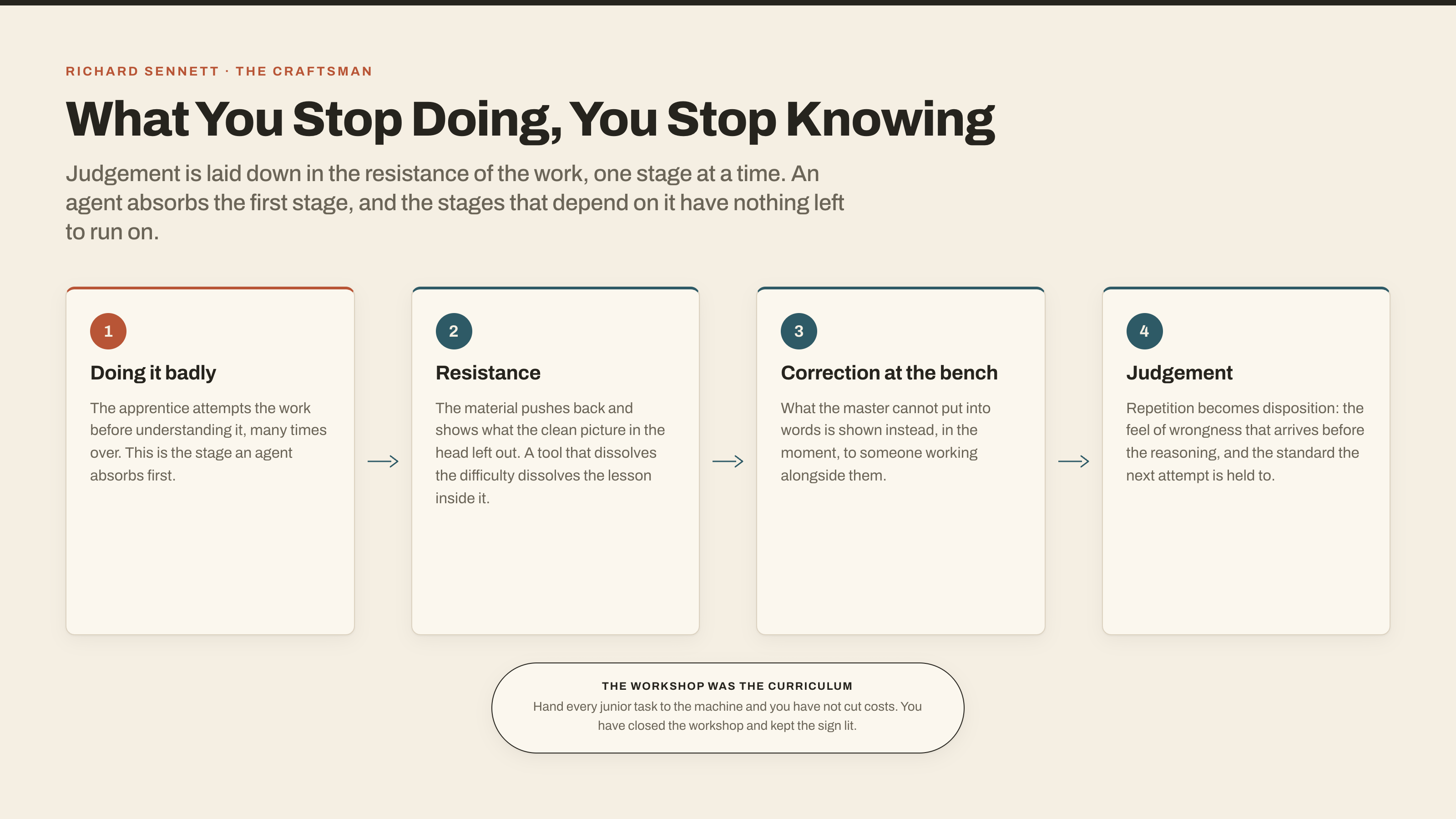
Instruction has a ceiling. You can give someone the rule. You cannot give them the feel. Bourdieu called it habitus: the durable dispositions that repetition lays down until they run beneath conscious thought. Habitus is what the workshop builds into the hand. It is acquired one way. You do the thing badly, many times, until the doing rewires the knowing. A craft explained is not a craft possessed.
3. Resistance is the teacher, and a smooth tool can dismiss it
Craft is built on difficulty. The material pushes back. The joint refuses to close. In fighting the resistance the craftsman learns what the clean picture in his head left out. Sennett’s warning about computer-aided design was not that the tool was bad, and the best architects reach for it. It was that a tool which dissolves the resistance dissolves the learning that lived inside the resistance. He walks through Atlanta’s Peachtree Center, five and a half million square feet of towers and hotels designed on screen. The plan fills the streets with well-drawn pavement cafés that the Georgia sun makes unusable. Nothing could fail on screen. Nobody saw the failure until it was concrete.
Programs that improve from their own data, Sennett wrote, tempt the craftsman to become “a passive witness to and consumer of expanding competence”. He watches a skill grow and does not acquire it. That was published in 2008. It describes an engineer who ships an agent’s code all day and cannot say how any of it works. The most powerful tool engineering has ever held is the most capable of turning the craftsman into a spectator. Which of the two it does is settled by how the work around it is arranged, not by the tool.
4. The workshop was the curriculum
Engineers already have a name for the shape of this. The agent carries seventy per cent of the code and the last part still needs a human. Osmani’s knowledge paradox adds that seniors use the agent to move faster through what they understand, and juniors reach for it to learn what they do not. Sennett supplies what that argument leaves out. He explains how the understanding got into the senior in the first place.
It got there at a shared bench. Before there were courses there were workshops. What passed between master and apprentice could not have been delivered as instruction, because most of what the master knew the master could not put into words. The apprentice worked beside him and was corrected in the moment. Not in a written review three days later. The correction came while the hand was still moving and the material was still in it. It was physical, it was immediate, and it came from someone who saw the error before the apprentice had finished making it. Sennett’s figure, taken from the research on expertise and argued over ever since, is that ten thousand hours of this makes an apprentice a master. The teaching was done by the arrangement: proximity, repetition, and somebody watching who already knew.
That arrangement is what an agent removes. The junior tasks were never cheap code that happened to go to juniors. The junior tasks were the bench. Give every one of them to the agent and you have closed the workshop and left the sign lit.
5. The corrosion began before the agent arrived
Craft was eroding long before the agent, and Sennett watched it go. In The Corrosion of Character he described how short-term, flexible employment dissolves the long horizons craft needs. Teams reform every quarter. Skills are declared obsolete on a roadmap. The patient accumulation of mastery stops paying. Eight years later, in The Culture of the New Capitalism, he named the fear that follows. He called it the spectre of uselessness: the dread of the skilled worker who suspects the system no longer wants what he gave a life to learning.
The agent did not make that condition. The agent makes it efficient. An organisation that already treated its engineers as interchangeable executors of tickets was starving craft before any agent arrived. The agent hangs a productivity number on the starvation. I suspect the teams that keep their judgement through this will turn out to be the teams that refused the corrosion years ago, for reasons that had nothing to do with agents at all.
6. Craft is a decision the organisation makes
The impulse to do good work is basic and nearly universal. It is not a rare temperament you interview for and hope to spot. Whether it grows or dies is set by how the work is arranged. The same person will care in one system and coast in another. The difference sits in the system and not in the soul.
So the question an agent puts to an engineering organisation is not whether to use it. Use it. The question is whether your use of it deepens the engagement that builds judgement or hollows it. Ask whether the people around it are becoming better craftsmen or better spectators. Ask whether the judgement your seniors carry is being passed on or spent down. You are running a workshop or you are emptying one. Nobody else will decide which.
Where this falls: Building, the third of four phases; Learning, Deciding, Building, Transforming. Sennett sits on Identity, the questions about who is building and what they can promise, because craftsmanship is the account of how judgement gets into a person in the first place. What an organisation gets out of that work is a system and the competence to keep it. The Build Is the Test sets out the argument these articles run on.
(An Organisational Prompt is something you can do now....)
Organisational Prompt
Give someone the work the agent could do
Each sprint, take one real task an agent could finish in minutes and give it to someone still building judgement. A senior reviews the result by hand and corrects it in conversation, not in a comment thread. Treat it as production and not as training. The task ships, and the point is that a person learned the craft of it.
Then look at what sits in your juniors’ queues. If it is only the work the agent could not do, you are spending senior judgement and making none. The bill arrives when the seniors leave and nobody behind them ever ran the bench. Reserve the apprenticeship on purpose, or lose it by default.
Further Reading
Richard Sennett, The Craftsman (Yale University Press, 2008). The first chapter, which contains the Peachtree Center material and the argument about computer-aided design, is freely available.
On the argument in section five, two more: The Corrosion of Character: The Personal Consequences of Work in the New Capitalism (W. W. Norton, 1998) for flexible employment and long horizons, and The Culture of the New Capitalism (Yale University Press, 2006), where the spectre of uselessness is named.
Addy Osmani, “The 70% problem: Hard truths about AI-assisted coding”, for the knowledge paradox in full.
I write about the industry and its approach in general. None of the opinions or examples in my articles necessarily relate to present or past employers. I draw on conversations with many practitioners and all views are my own.