
Forty minutes into the review, somebody says a name. It comes out as a clarification rather than an accusation, and the room relaxes immediately, because the question of what happened has just been converted into the question of who, and the second question has an answer. Twenty minutes later there is an action list. Nobody in that room is a bad person and nobody set out to do this.
What you have just watched is an organisation declining to learn, efficiently and with everyone’s cooperation. This is the commonest resolution of a crisis anywhere, it works, and it leaves the organisation exactly as it was, minus one person. These articles are about the alternative, and about how somebody has to choose it deliberately, in front of everyone, while the pressure to do the other thing is at its highest.
Three phases have run. Learning asked what an organisation has to be like before anything can get through to it, and found that learning is a condition rather than a process. Deciding asked how choices get made under constraint, and found that a decision is a design problem and design is a sequence of decisions. Building asked what happens to the craft when making becomes cheap, and found that judgement, verification and coordination are what remain. Each part handed something to the next. Building hands this one an organisation that has learned to describe what it made, and now has to decide what that description means for how it is led.
The claim here is narrow and it costs something to accept. Leading is taking a position on how change resolves. Not starting the change, not driving it, not owning it. Taking a position on how it ends, at the moment when it could end several ways and the cheap way is the one everybody is already moving towards.
1. The event you did not make
Start with what a leader cannot do, because most leadership writing starts with what a leader can.
The argument running under this whole series is that organisations are not changed by people. They are changed by events. An event is something that happens which makes the existing account of what is possible untenable, in public, in front of witnesses who cannot unsee it. The demo that works. The outage that reveals what everyone privately suspected. The competitor who ships the thing your architecture said would take two years. After an event, the sentence “that is not how we do things here” stops being an argument and becomes a description of a place that no longer exists.
Leaders do not manufacture these. That claim gets resisted, because a great deal of consulting revenue depends on the opposite one. Kotter’s first step is to create a sense of urgency, and thirty years of practice have shown what that produces when there is no actual event underneath it: anxiety without information. People can tell the difference between a crisis and a slide about a crisis. Manufactured urgency spends the organisation’s attention and buys nothing, and it makes the next real event harder to hear, because the alarm has already been sounded once for nothing.
What a leader can do is create the conditions in which a latent crisis surfaces as an event rather than being discharged quietly. Michael Jackson’s word for the leader’s job in a systems intervention is close to what is needed here: the agency is custodial. You hold the space. You choose the approach and defend it in the open, and you sustain what previous change achieved. The rupture is not yours to generate. Believing you did is the most common and most expensive self-deception in this trade.
2. Why the room reaches for a name
Back to the review meeting. Something has gone wrong, the account that explained the world has failed, and the discomfort in the room is real and rising. René Girard spent a career on what happens next, and his answer is unpleasant enough that people usually hear it once and then forget it deliberately.
Girard’s starting point is that desire is imitative. We want what we see others wanting, which means that the closer two parties are, the more likely they are to want the same thing and to become rivals over it. Rivalry spreads by the same imitation that started it. What began as a difference of position becomes a general condition in which everybody is behaving identically and nobody can tell the factions apart. Girard calls this the crisis of undifferentiation, and it is recognisable in any organisation where a real problem has turned into eight teams briefing against each other about the same problem.
The crisis resolves, historically and reliably, through a single victim. The community converges on one person or one group, the choice is more arbitrary than anyone involved believes, and the expulsion produces genuine relief. Peace returns. And the mechanism conceals itself: the participants do not experience it as scapegoating, they experience it as having correctly identified who was responsible. A room that has just scapegoated somebody does not feel like a mob. It feels like a group that has finally, after some difficulty, got to the bottom of things.
You do not need a corporate execution for this to be running. The modern forms are gentler and just as effective. The reorganisation that removes one function. The supplier who becomes the reason. The departing executive whose leaving explains everything that happened for two years. Each converts a systemic question into a personnel answer, and the relief is real, which is precisely the problem, because relief is what the organisation was seeking rather than understanding.
3. Refusing the cheap resolution
If the leader cannot make the event, the leadership sits in what happens to it. And the first thing that happens to any event is that the organisation tries to close it, fast, with the least expensive story available.
Refusing that is the central act. Nothing about it is grand. Usually it is one sentence in one meeting, said by the person with enough standing to be listened to, and it costs them something with everybody present.
Ronald Heifetz supplies the operational half of this. His term for the state the organisation is in after an event is disequilibrium, and his finding is that adaptive work only happens inside it. Too little and nobody changes anything; too much and people panic, regress, and reach for a scapegoat. The leader’s job is thermostatic: keep the heat inside the productive band, and resist the pressure to relieve it. Every instinct in the room, including yours, wants the temperature down. The reward for lowering it is immediate. The cost is that the organisation returns to exactly the state that produced the event, having learned that the event was one person’s fault.
Alasdair MacIntyre gives this its philosophical shape, and his term is more precise than “crisis”. A tradition, meaning any community with shared standards for what counts as good work, enters an epistemological crisis when its own resources stop being able to resolve its own problems. Argument stops converging. The tests that used to settle things no longer settle them. The way out, when there is one, is not a return to first principles: it is the arrival of a new account that solves the problem and also explains why the old account failed and had to fail. That second condition is the demanding one, and it is what separates a real resolution from a scapegoat. Naming a person explains nothing about why the standards stopped working.
So the test in the room is quick. Does the proposed resolution explain why the previous account was inadequate? If it does not, it is a story about a person, and the organisation is about to buy peace with information it needed.
4. The window that opens straight afterwards
Something happens to language in the weeks after a genuine event, and organisations consistently fail to use it.
The received wisdom is that changing how an organisation talks takes years. Mostly true. The exception is short and it is the one you can use. George Lakoff’s work on framing explains why. Frames are not decoration on top of an argument; they are the structures that decide which facts count as relevant and which conclusions feel obvious. They are built up by long repetition, and they hold because the world keeps confirming them. Lakoff’s famous demonstration is that a frame cannot be fought by negating it, because the negation invokes it. Tell people not to think of an elephant. The elephant is already there. Argue against tax relief and you have conceded that tax is an affliction.
Now put that beside an event. The event’s whole function is to break the confirming evidence. For a short period the old frames are unsupported, and vocabulary that would have been rejected as naive six weeks earlier installs quickly and sticks. This is why the language an organisation uses about AI was mostly set in a two-month period nobody planned, by whoever happened to be speaking with confidence at the time.
The stakes are practical, because the metaphor decides the policy. Call the system a copilot and you have implied a human in command, a defined cockpit, and a division of labour that mostly does not exist. Call it an agent and you have implied something that acts on its own account, which raises the question of what it may promise on your behalf and to whom. Call the programme adoption and it is a rollout with a completion date. Call it capability and it is a standing investment with no end. None of these are the same organisation eighteen months later, and the choice between them is usually made by accident, in the first fortnight, by whoever wrote the deck.
The leader’s job at this position is to have the vocabulary ready before the window opens, and to use it immediately when it does. That sounds cynical. It is the opposite: the alternative is not neutrality, it is somebody else’s frame arriving by default.
5. Settling, which is not the same as finishing
New language that does not become structure evaporates. Everybody in this trade has watched a vocabulary flourish for one quarter and disappear, because it never got into the standards, the funding lines, the review gates or the job descriptions.
Kurt Lewin is the thinker at this position, and there is a correction to make before he can be used, because most of what is taught under his name he did not write. The three-step model of unfreeze, change, refreeze is the most cited framework in change management, and the archival work of Stephen Cummings, Todd Bridgman and Kenneth Brown shows it was assembled by later writers and attributed backwards after his death in 1947. Lewin used the ice-block image in passing. He did not propose a three-stage method, and the model that carries his name arrived with an assumption he would probably have rejected: that change is an interval between two periods of stability.
What Lewin actually gives you is better. Field theory holds that behaviour is a function of the person and the environment together, so if you want different behaviour you change the field rather than exhorting the people. Force field analysis follows directly: any current state is held in place by driving and restraining forces in rough balance, and the productive move is almost always to remove restraint rather than to add drive. Most transformation programmes do the opposite. They add incentives, campaigns, dashboards and mandates on top of restraints nobody has touched, and then wonder why the field snaps back.
And action research, which he also founded, treats the intervention itself as the way you learn about the system. Studying an organisation and then changing it is the wrong order. You change something and find out what it was.
Read that way, the settling at the end is provisional by design. Structure has to be built so that the next event can unfreeze it, which means writing down what would have to be true for this arrangement to be wrong. An end state that has quietly announced it will resist the next event will keep that promise.
6. Why the rotation starts where it does
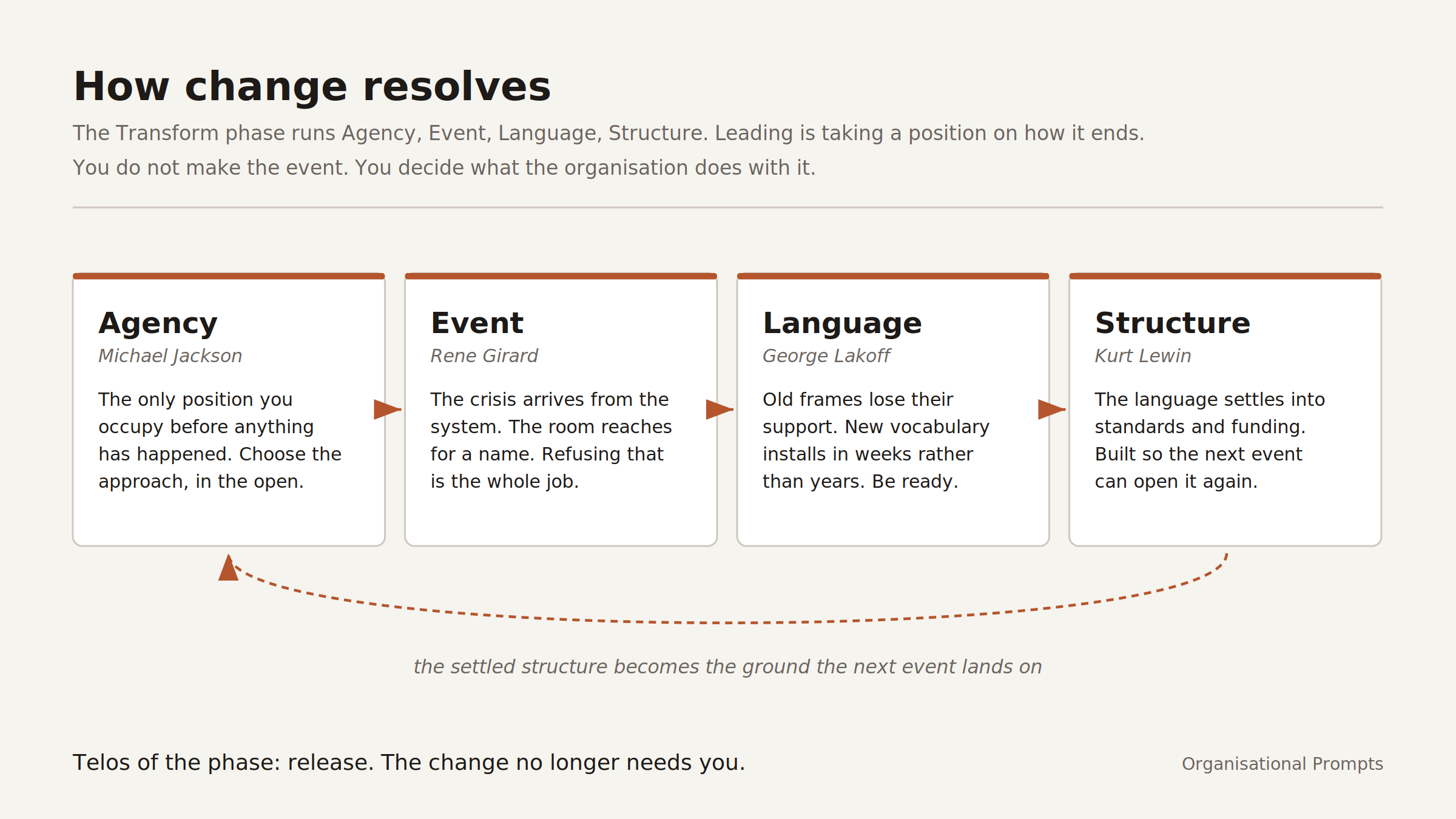
Each part of this argument moves through the same four positions, and the order changes according to what it is for. This one runs Agency, then Event, then Language, then Structure.
It starts at Agency because that is the only position a leader occupies before anything has happened. No event has happened yet. What exists is a person with a role, some standing, a set of prior commitments, and a choice about what kind of leader to be when something does. What they do with that determines whether the latent crisis in the organisation surfaces as an event at all, or gets discharged in the quiet ways organisations have for keeping the peace.
Then the event arrives, from the system rather than from the leader, and the leader’s position on its resolution decides everything downstream. Language follows, in the window the event opens. Structure comes last, holding the language long enough for it to become how things are done, and built to be opened again.
Where the previous phases ended by handing something forward, this one ends by handing something back. The settled structure becomes the ground on which the next disruption lands, which is where Learning began. The whole shape of the argument sits in that handover: not a programme with a completion date, but a cycle that leaves the organisation better at recognising and using the next event than it was before.
7. Release
Each part has a single word for what it is trying to produce. Learning was fidelity, the discipline of staying faithful to what an event revealed rather than to what was comfortable. Deciding was actuality, the insistence on the situation as it is rather than as reported. Building was simplicity. This one is release.
Release is the least fashionable of the four and the hardest to fake. It means the change no longer requires you. The vocabulary is in the standards, the structure holds without your attention, the people who must do the work are doing it, and your continued presence adds nothing to it. A leader who cannot release has not finished a transformation; they have built a dependency and given it a name.
The personal cost of this is real and rarely stated. The reward structure of most large organisations is set up to punish exactly this. Visible ownership of a live programme is career capital. A programme that no longer needs you is a programme somebody else can be given. I have watched capable people hold on to a transformation months past the point where holding on was the only thing slowing it down, and in every case they could have told you the theory perfectly.
Release is also what makes the flywheel turn. An organisation that has been through one full cycle and been released is measurably better at the next one. It carries a memory of an event that produced something rather than a casualty. Its language is language it trusts. Its structure is structure it knows to be provisional. The next event arrives into an organisation with more capacity than the last one had, which is the only definition of transformation this series is willing to defend.
8. What this is not
Two things, so that expectations are set correctly.
Nothing here is about leadership styles. There will be nothing here about whether you should be more visionary or more servant, and no quadrants. The question is not what kind of person you are; it is what you do in the twenty minutes when a crisis is resolving and the cheap option is on the table.
Nor is it heroic. The custodial reading of agency cuts both ways: it relieves you of the fantasy that you cause change, and it hands you a duty that is harder than causation. You have to be present, in the room, holding a position that costs you something, at the moment when everyone in it would rather the discomfort stopped. That is a smaller job than the one on the conference stage, and the one that decides whether anything survives.
The rest of these articles is about how to do it, thinker by thinker, and about what to do when it goes wrong, which it will.
Where this sits: Transforming, the last of the series' four phases; Learning, Deciding, Building, Transforming. It starts at Agency, because building hands over knowledge and capability rather than a crisis, and nothing about that compels anybody to act. What an organisation gets out of the work that follows is release: the change carries on without the internal agent who initiated it. From Building to Transforming is the bridge into it.
(An Organisational Prompt is something you can do now....)
Organisational Prompt
Write the two sentences before you need them
Think of the last significant failure in your organisation, the one that got a review and an action list. Find the meeting notes if they exist.
Answer one question honestly: did the resolution explain why the previous account of how things worked was inadequate, or did it identify a person, a team or a supplier? If it identified someone, the organisation bought relief and paid for it with the information it needed.
Now write two sentences and keep them where you can reach them in a meeting. The first refuses the cheap resolution without accusing anyone of seeking it: something close to “before we agree what happened, I want to be clear about what we thought was true that turned out not to be.” The second is the vocabulary you want installed if the window opens: one phrase, chosen deliberately, that you will use the same way every time for the next six weeks.
Both sentences take ninety seconds to prepare and are almost impossible to compose under pressure. That is why you write them now.
Further Reading
René Girard, The Scapegoat (Johns Hopkins University Press, 1986). The mechanism set out at book length and without the literary apparatus of the earlier work. Unsettling in a way that is difficult to shake off afterwards.
Ronald Heifetz, Leadership Without Easy Answers (Harvard University Press, 1994). Still the most useful thing written about what a leader does when there is no answer to supply.
George Lakoff, Don’t Think of an Elephant! (Chelsea Green, 2004, updated 2014) is the popular version. His Framing 101 essay is free in full and covers the essentials in a few pages.
Stephen Cummings, Todd Bridgman and Kenneth Brown, Unfreezing change as three steps: Rethinking Kurt Lewin’s legacy for change management (Human Relations, 2016). The archival work showing that the field’s founding model was never proposed by the person it is credited to. Read it before you draw the three boxes again.
I write about the industry and its approach in general. None of the opinions or examples in my articles necessarily relate to present or past employers. I draw on conversations with many practitioners and all views are my own.