
Psychological safety is the most cited and least practised idea in management. The term has gone decorative: leaders invoke it in all-hands meetings and then ignore it in every interaction where honouring it would cost them something, which is every interaction that matters. Underneath the dilution sit three decades of evidence, starting with a 1999 paper in Administrative Science Quarterly. What best predicts whether a team learns is not talent, resources or strategy. It is whether the people on it believe they can speak honestly and not be punished for it.
Amy Edmondson has spent three decades producing the evidence. Her research runs across hospitals, technology firms, manufacturing plants and financial services, and by the time she wrote The Fearless Organization in 2018 the finding held in all of them. The teams that learn fastest and perform best are not the ones with the fewest errors. They are the ones that report the most. Not because they make more mistakes, but because they work somewhere mistakes surface, get examined and produce improvement, rather than being hidden, explained away or pinned on a person. If you are running a transformation, that finding is aimed at you.
1. What Psychological Safety Actually Is
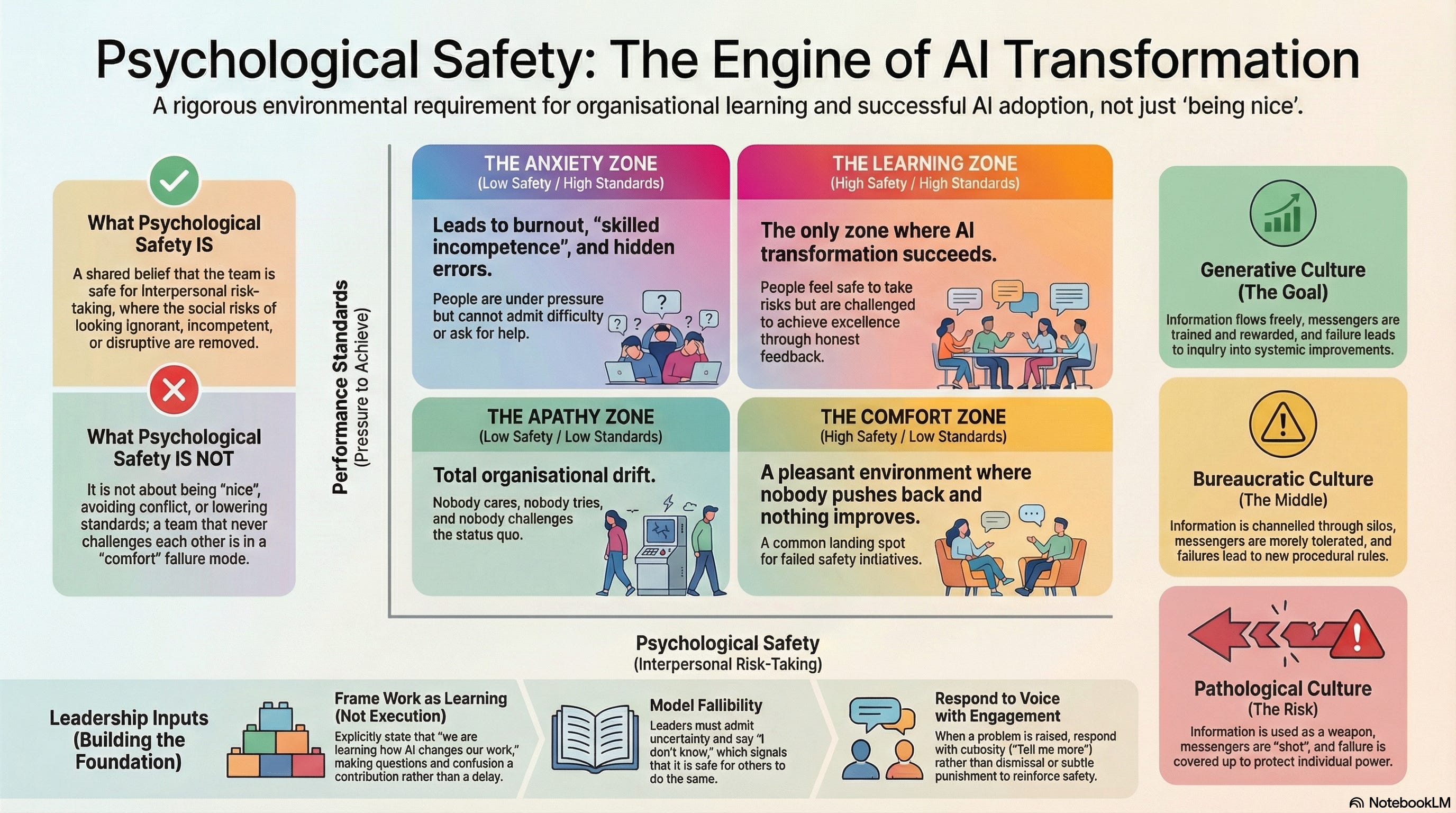
Edmondson defines psychological safety as the shared belief that a team is safe for interpersonal risk-taking. Three words carry the definition: shared, belief, and interpersonal risk. Safety is not an individual trait but a property of how the group interacts, and it is not about objective conditions but about what people believe those conditions to be. The risks in question are social: looking ignorant, incompetent, negative or disruptive.
Every act of learning at work carries one of those risks. Asking a question risks looking ignorant, admitting a mistake risks looking incompetent, and challenging a decision risks looking negative. Where any of those risks carries a real cost, a dismissive reply, a line in the performance review, a quiet exclusion from the next conversation, silence is the rational answer.
Silence is how organisations stop themselves learning.

Argyris found the same mechanism from another angle. His defensive routines are what low psychological safety looks like as behaviour. People run Model I, which is unilateral control, suppressed feelings and winning, because the environment has taught them that Model II, which surfaces assumptions and tests reasoning in public, is dangerous. Edmondson names the environmental variable that Argyris implies and never isolates. Argyris tells you what people do in an unsafe environment; Edmondson tells you what would have to change for them to stop.

Bateson shows what is at stake. Without safety the organisation is locked at Learning I, correcting errors inside the existing frame, because questioning the frame carries too much interpersonal risk. The defensive routines that block Learning II are not cognitive failures. They are rational adaptations to an environment that punishes Learning II. Safety comes first because nothing else can.
Comfort is the thing safety gets confused with, and the confusion is expensive. Being safe is not the absence of tension or the avoidance of conflict. It means trusting that tension, conflict and honesty will be treated as contributions rather than as grounds for punishment. A team where everyone agrees, nobody challenges and hard topics go unmentioned is not safe. That team is comfortable, and comfort is a failure mode.
2. The Two-by-Two That Changes Everything
Popular accounts of Edmondson leave this out. Psychological safety on its own does not predict performance. What predicts performance is safety combined with high standards. That gives you a matrix, and you can locate your own organisation on it in about a minute.
Low safety with low standards is the apathy zone. Nobody cares and nobody tries. Low safety with high standards is the anxiety zone, where people are under pressure to perform and cannot admit difficulty, ask for help or report a problem. Argyris spent a career documenting that zone, and it produces the learned helplessness Seligman describes: high pressure, no safety, repeated failure with no route out. High safety with low standards is the comfort zone, where people feel safe and are never challenged. That is where most organisations land when they set out to build psychological safety without raising expectations at the same time.
High safety with high standards is the learning zone. People feel safe enough to take a risk and are challenged enough that they have to. Mistakes surface and get examined. Feedback is honest and frequent. This is the only zone where AI transformation produces capability rather than cosmetic adoption. Deci and Ryan describe what that zone feels like from inside: autonomy in how you engage with the challenge, competence as mastery grows, relatedness from learning alongside other people. Edmondson supplies the architecture that lets those conditions exist or prevents them.
3. The Leader’s Shadow
Where does safety come from? Edmondson’s answer is uncomfortable. Team safety is set almost entirely by the behaviour of the team leader, and not by policies, values statements or training programmes. It comes from the specific, observable behaviour of the most powerful person present.
Three behaviours predict team safety more reliably than anything else. The first is framing the work as a learning problem rather than an execution problem: we are learning how AI changes our work, and nobody including me knows exactly what that will look like. The second is modelling fallibility, which means admitting uncertainty, acknowledging mistakes and asking for help. When the most powerful person present says they do not know something, it becomes safe for everyone else to say it. Stacey would call that a gesture: one act that changes the conditions for the next conversation, amplified by the power sitting behind it.
The third is responding to voice with engagement rather than punishment. Somebody raises a problem, and what happens next decides everything. Curiosity reinforces safety. Deflection destroys safety. One instance of punishment undoes months of stated commitment to openness.

Dweck, whose work on mindset ran through the 1990s and 2000s, explains why the leader matters this much. In a fixed mindset culture, a leader who admits ignorance breaks the implicit contract that leaders are supposed to know, because their authority rests on expertise. In a growth mindset culture the same admission is leadership. Bourdieu adds the depth underneath. The leader’s habitus, formed over years in an environment that rewarded certainty and punished vulnerability, generates the safety-destroying behaviour automatically, below conscious choice. A leader who sincerely wants to model fallibility may find their own dispositions producing the opposite: confident assertions, deflected questions, the smooth impression management Goffman described. Changing the behaviour means changing the habitus, and habitus changes through practice rather than intention.
4. From Team Safety to Organisational Culture
Edmondson works at the team level. Westrum’s typology supplies the level above. Pathological cultures punish the messenger, bureaucratic cultures channel the messenger, generative cultures train and reward the messenger. A generative culture, seen inside one team, is exactly the safety Edmondson measures. You cannot sustain it in a team sitting inside a pathological culture, because the pathological dynamics will outlast any team leader.

Dekker takes safety into failure response. His substitution test asks whether another similarly trained person would have done the same thing, which moves attention off the individual and onto the system. That move is the shift from single-loop to double-loop learning Argyris described, and it needs safety to work at all: without safety, nobody gives you the honest account the test depends on.
The dependency runs both ways. Without team safety a generative culture cannot exist, because the information flow Westrum describes runs on the interpersonal risk Edmondson measures. Without a generative culture team safety cannot persist, because the structures Giddens describes, the performance review that penalises admitting a mistake, the incentive that rewards individual performance over team learning, will eventually beat any team leader’s efforts to hold safety in place.
5. The Structural Trap
The commonest response to this research is a programme. We will build psychological safety. Giddens would spot the contradiction immediately. A safety programme that leaves the performance review, the promotion criteria and the governance framework untouched changes signification, which is the story about what is valued, while leaving domination and legitimation exactly as they were. It produces a new espoused theory over an unchanged theory-in-use. Argyris, writing in Harvard Business Review in 1991, called that the standard gap between what organisations say and what they do, and added that the gap itself is undiscussable.

Peters gives you the practical test. Do not read the values poster. Walk the floor. Watch what happens when somebody challenges a decision in a meeting. Genuine engagement means safety is real. Any deflection, dismissal or delayed retaliation means safety is a performance. Where safety is performed and not practised, people learn one lesson very precisely: the stated rules are not the actual rules. That is the learned helplessness Seligman describes, and it resists intervention because the organisation refreshes the evidence for it every week.
Safety cannot be installed. It has to be demonstrated, in specific moments, by specific people, with consequences that contradict what everyone has learned to expect. A leader who changes a decision in a public meeting because a junior person challenged it has done more for psychological safety than a year of workshops. These are Weick’s small wins applied to trust: concrete, visible acts that change what people believe about the cost of speaking up.
This is a Learning article. The series runs Learning, Deciding, Building and Transforming, and the first of those asks whether an organisation can perceive its own situation at all; safety is what decides whether anybody says what they have seen. What an organisation gets out of that work is not comfort but reportable information. In Deciding the question becomes what can be designed from it, and From Learning to Clarity is where the question changes.
(An Organisational Prompt is something you can do now....)
Organisational Prompt
At your next team meeting, before any agenda item, say that you want to start with a question you genuinely do not know the answer to. Then ask it, and make it real. What about our current approach is not working, and why has nobody raised it? Then be silent. Wait.
The next 60 seconds will tell you where your team actually sits. If someone speaks honestly, and says something that surprises you, answer with curiosity rather than correction. Ask a follow-up. Take a note. Before the meeting ends, commit to one specific action based on what you heard. That commitment, visible and immediate, is what changes people’s beliefs about whether speaking up is worth it.
Further Reading
Amy Edmondson, The Fearless Organization (2018). The definitive statement of the research for a practitioner audience. The two-by-two of safety and standards is the most useful diagnostic in the book.
Amy Edmondson, Psychological Safety and Learning Behavior in Work Teams (Administrative Science Quarterly, 1999). The foundational paper. Read it for the methodology and the nuance the popular accounts compress. Freely accessible.
Amy Edmondson, Teaming: How Organizations Learn, Innovate, and Compete in the Knowledge Economy (2012). The research applied to team structures that keep changing shape, which makes it relevant to AI transformation as capabilities evolve.
Chris Argyris, Teaching Smart People How to Learn (Harvard Business Review, 1991). The mechanism beneath the environmental finding. Argyris supplies the individual psychology and Edmondson supplies the condition around it.
I write about the industry and its approach in general. None of the opinions or examples in my articles necessarily relate to present or past employers. I draw on conversations with many practitioners and all views are my own.