
Two rooms can be built to the same specification and only one of them is alive. You know it on entering, before you could say why: one room is comfortable, settled, somewhere you would choose to sit; the other is correct and dead. The specifications match. The materials match. Something the specification did not capture is the whole difference, and an organisation that cannot name that something will keep producing the dead version and signing it off as done.
Christopher Alexander spent fifty years on that something. He was an architect and a mathematician, after one question. Why are some places alive and most are not? And can the difference be taught? The answer he built is the most complete account in this series of what design actually is. For Deciding he is unavoidable. I have argued throughout this phase that decisions are design challenges, and that design is a sequence of decisions under constraint. Alexander worked that argument out in full first. He was building real buildings, and watching most of them fail to come alive.
1. A Pattern Is a Decision That Recurs
Alexander’s early work, Notes on the Synthesis of Form, treated design as the achievement of fit between a form and its context. A design problem is a knot of interacting requirements; the designer’s task is to find the places where the requirements cluster tightly and the places where they barely touch, and to cut the problem along the loose seams into sub-problems that can be solved nearly independently. Simon reached the same insight about complex systems in the same decade. The two men had little contact and were building one idea: a problem becomes tractable only when it is cut where its real seams are.
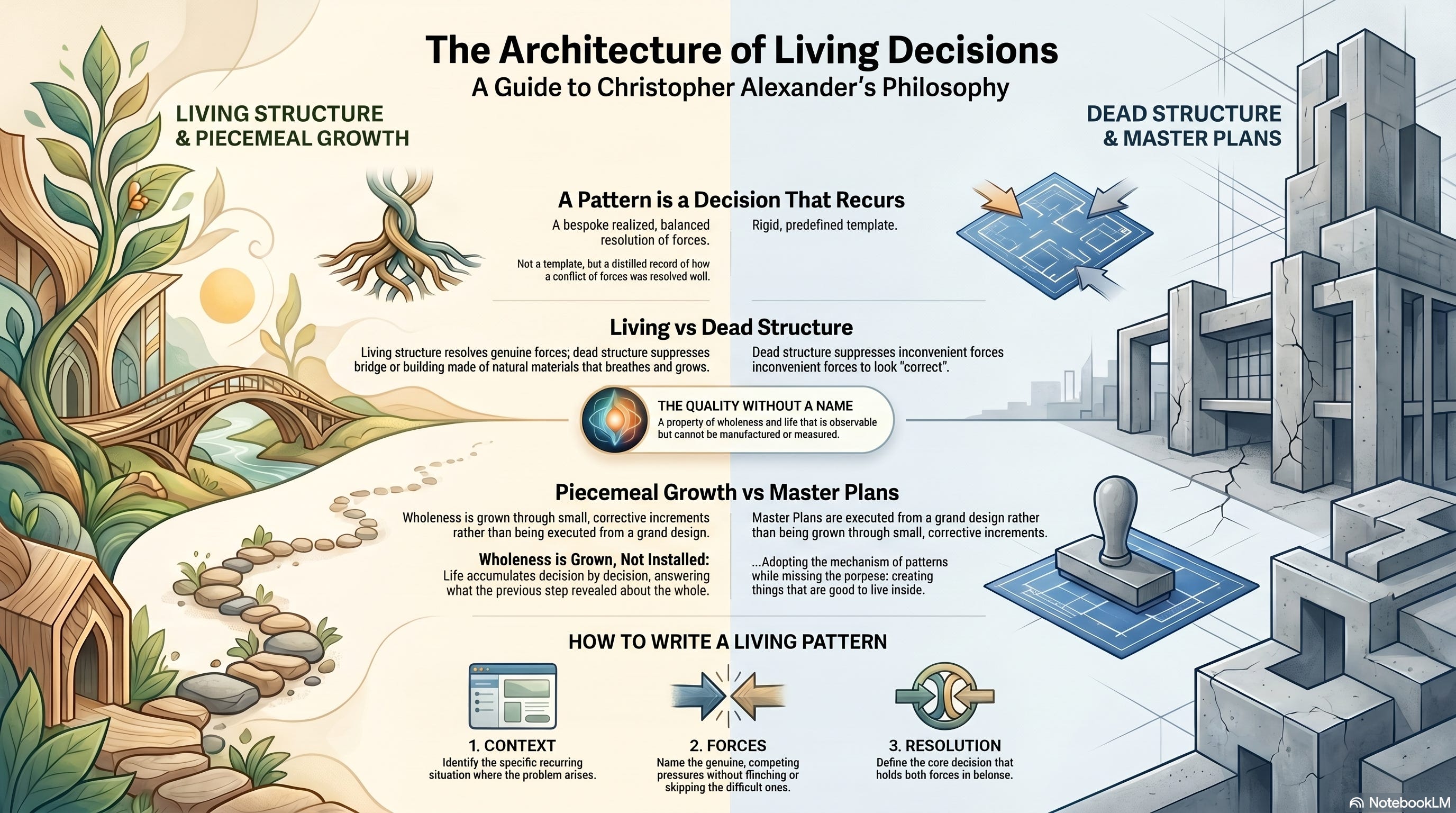
Decomposition was the analytical half. The generative half came later, and that is the pattern. In Alexander’s mature definition, a pattern is a recurring problem in a context, stated together with the core of a solution that resolves the competing forces the problem creates. Light on two sides of a room. A place to wait that is also a place to be. The exact form is never specified, because it will be built a thousand times and never twice the same; what is specified is the conflict and its resolution.
Hold on to what a pattern actually is. Not a template. Not a reusable component. A decision that recurs, captured. It is the distilled record of how one conflict of forces was resolved well, written down so the next person facing that conflict reuses the decision rather than the object. Build a library of your patterns and you are not building a catalogue of solutions. You are building a memory of your good decisions. That is a different and far more valuable thing.
2. The Forces Are the Point
The centre of a pattern is the field of forces: the genuine, competing pressures the situation creates. A room needs daylight and needs shelter from glare. An entrance needs to welcome and needs to secure. The forces are real, they pull against each other, and a pattern should earn its place only if its resolution actually holds both rather than sacrificing one.
This is the test Alexander cared about most, and it is the test most often skipped. Used to decorate, lifted in because it is familiar or because it looks like the kind of thing one does, a pattern resolves nothing; it suppresses one force and calls the suppression a design. His word for the result is dead structure. The building stands. The building is also lifeless, because the conflicts it was supposed to resolve are still there, merely hidden under a form that ignored them.
The organisational translation is direct, and it sharpens a distinction these articles have returned to repeatedly: the difference between a decision made and a decision performed. Name the competing forces honestly and resolve them and the decision is alive. It holds. Pick the comfortable option and suppress the inconvenient force and the decision is performed. It looks like a decision and probably will not hold, because the suppressed force is still pulling and will surface again, later and more expensively. He gives the phase its cleanest tool for telling the two apart. Ask of any decision which forces it claimed to resolve, then whether it resolved them or merely quietened the one complaining loudest.
3. The Quality Without a Name
The companion volume of 1979, The Timeless Way of Building, names the thing the patterns serve, and then refuses to name it with a single word. Alexander calls it the quality without a name: the property of being alive, whole, comfortable, free, exact, that some places have and most do not. The refusal was deliberate. Every available word, beauty or harmony or elegance, was too small and would be mistaken for a style.
The quality cannot be manufactured. That is the hard claim, and the one that matters here. You cannot specify wholeness in advance and have it executed, the way you might specify a dimension. Wholeness can only be generated, grown by applying a pattern language honestly to the actual forces of an actual situation. A place tends to come alive when each decision in the sequence genuinely answered the conflict in front of it, and to stay dead when the decisions were taken from habit, or from the catalogue, or to satisfy a sign-off.
For senior technologists this should land as something other than a metaphor. I have never met a technologist who has not seen it: the system, the team structure, the operating model that is correct on every measurable axis and somehow inert. Nobody wants to work in it. Nothing moves easily through it. No single defect explains the deadness. Alexander’s account says the deadness is real, diagnosable, and caused: it is what you get when a thing is assembled from decisions that did not resolve real forces. And it says the quality is observable rather than measurable, which is exactly the standard this series sets for everything it asks you to look for. You cannot put a number on whether a structure is alive. You can tell.
4. Wholeness Is Grown, Not Installed
If the quality can only be generated, then the method has to be generative, and Alexander’s later work is an attempt to say precisely how. Wholeness, he argued, is made of centres. These are local zones of coherence that strengthen one another, and a thing is alive to the degree its centres intensify rather than compete. And it grows by structure-preserving transformation: each healthy change strengthens the centres already present instead of erasing them. Change unfolds what is there. It does not demolish and replace.
That rejects the master plan directly, the big design fixed in advance and executed whole. Anyone who has watched a three-year transformation programme arrive complete and lifeless will feel the force of it. His alternative is piecemeal growth. Small increments, each corrected against the actual state of the whole as it stands, never one grand design imposed at once. In the vocabulary of modern delivery this is iterative development. Alexander reached it decades before the software industry did, and for deeper reasons. Continuous, incremental, structure-preserving change is not a project-management preference. Incremental growth is the only process that produces something alive, because wholeness cannot be specified ahead of the building; it can only accumulate, decision by decision, as each step answers what the last step revealed.
5. The Patterns Movement, and What It Missed
His idea crossed into software. The design-patterns movement of the 1990s took the form of the pattern directly from him, and the influence runs through the catalogues of reusable solutions that a generation of engineers grew up on. In 1996, at OOPSLA, Alexander was invited to address that community, and he used the platform to tell them, with care, that they had taken his patterns and missed his point.
The patterns, he said, were never about reusable solutions. They were about generating life and wholeness, about making places and things that were morally good in the sense that they made the people who used and built them more alive. The software community, he observed, had adopted the mechanism and dropped the purpose: it had a method for cataloguing solutions and had not asked whether the systems it built were good to live inside.
The warning is this series’ warning, and it is why Alexander belongs in Deciding rather than merely near it. Detached from its forces, a pattern becomes dead structure. A framework adopted as a catalogue, applied because it is the done thing rather than because it resolves a conflict that genuinely exists, becomes exactly the framework worship the series has rejected from the start. Alexander is the proof that a powerful idea about design survives only if it stays attached to the question of whether the result is alive. Drop that question and you keep the vocabulary and lose the thing the vocabulary was for.
Where this falls: Deciding, the second of the series' four phases, after Learning and before Building and Transforming. A pattern is a description of a conflict and its resolution, which is exactly what this phase exists to produce. Building then finds out whether the resolution holds under load. From Deciding to Building is the bridge, and Why Your Organisation Can't Decide the synthesis that closes the phase.
(An Organisational Prompt is something you can do now....)
Organisational Prompt
Take a recurring problem your teams keep re-solving, and write it up as a pattern.
Pick something that comes round again and again; a kind of integration that is always painful, a review that always stalls, a handoff that always loses information. Write it as a pattern, in three parts.
First, the context: when and where does this problem arise.
Second, and this is the part that does the work, the forces: the genuine competing pressures the situation creates, named without flinching, including the inconvenient one.
Third, the resolution: the core of what actually resolves both forces, not the form, the decision. Now look at how your organisation currently handles it.
If the current handling suppresses one of the forces rather than holding both, you have found a decision that was performed rather than made, and you have found why the problem keeps coming back. The pattern is not paperwork. It is the captured decision, and writing it honestly is the first time the decision is genuinely taken.
Further Reading
Christopher Alexander: Notes on the Synthesis of Form (1964). Design as the achievement of fit, and the decomposition of a problem along its real seams.
Christopher Alexander, Sara Ishikawa and Murray Silverstein: A Pattern Language (1977). The 253 patterns, each a recurring problem and the core of its resolution, linked into a generative language.
Christopher Alexander: The Timeless Way of Building (1979). The philosophy the patterns serve: the quality without a name, and the generative process.
Christopher Alexander: “The Origins of Pattern Theory” (1996 OOPSLA keynote). His address to the software community on what the patterns movement took from him and what it missed.
The Hillside Group: https://hillside.net/patterns/ - a repository of early patterns from a stalwart of the patterns movement in software.
I write about the industry and its approach in general. None of the opinions or examples in my articles necessarily relate to present or past employers. I draw on conversations with many practitioners and all views are my own.